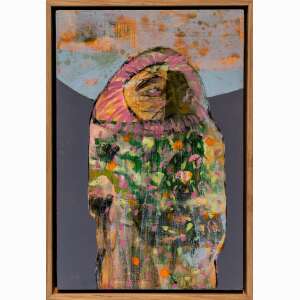
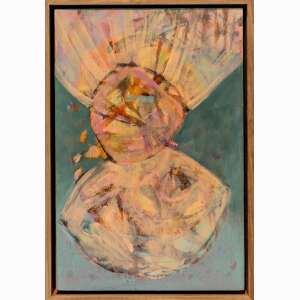
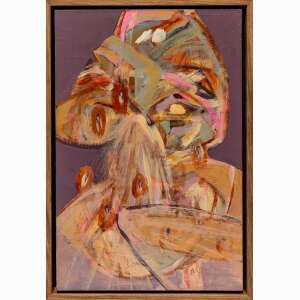
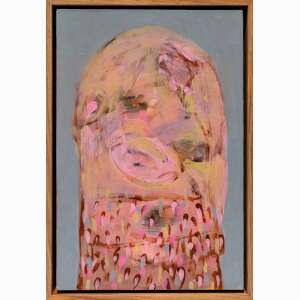
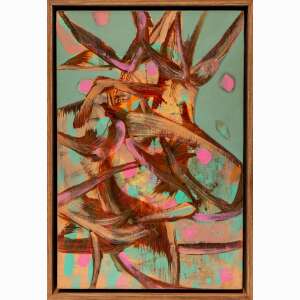
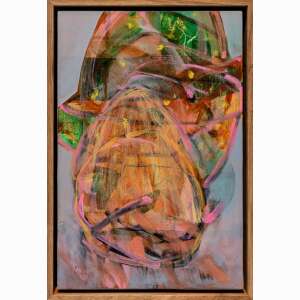
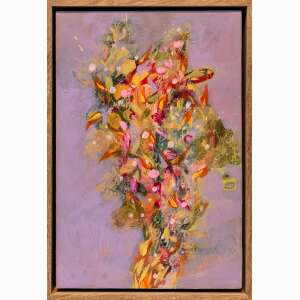
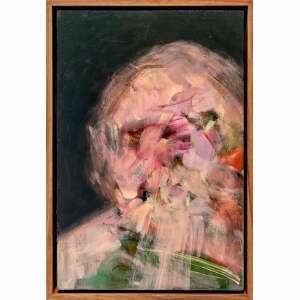
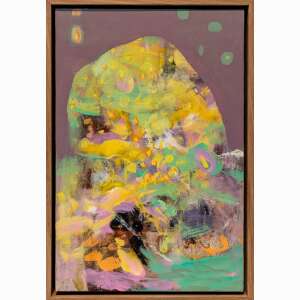
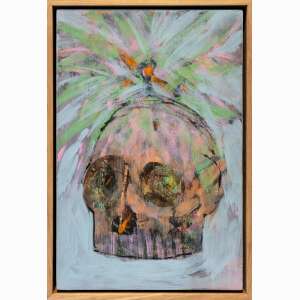
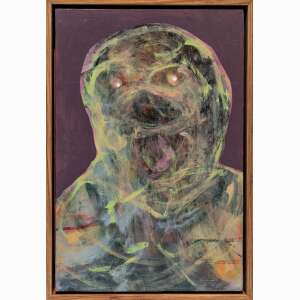
‘Landscape is itself a physical and multisensory medium (earth, stone, vegetation, water, sky, sound and silence, light and darkness). W.J.T. Mitchell’s view captures the rich complexity of the world we inhabit, which also inhabits us. Our place in the world is multisensory and profoundly elemental. This is the insight and understanding that informs Marc Standing’s vision. A Zimbabwean painter, a global citizen, no place however has inspired him more than Southern Africa – its infinite breadth, depth, sky, heat. ‘My childhood memories are overwhelmingly filled with freedom, sunlight and adventure,’ says Standing. ‘Much of it was spent on Lake Kariba.’ ‘The landscape left a profound impression on me: vast African skies, dead trees rising from the water like ghosts, wildlife moving through the bush, cicadas humming in the heat, animal bones bleached by the sun, and nights illuminated by stars and comets. The sense of wonder, mystery and solitude I experienced there continues to echo through my work today.’
One senses that the artist has absorbed the world of his childhood entirely. It is as though Standing has soaked up the very depths of the sun. There are ghost worlds, there is heat. Standing’s landscapes are not picturesque. He is not interested either in the grandiose or in prettification. Rather, we are thrust into knotted thickets, lush succulence, a world at once dense yet expansive. It is his deep attention to the sensation of a detail, the feeling of an undergrowth, the feral moment when culture encounters wildness, that gives his paintings their power. Ghostly yet heat-struck, there is something intimately seductive about Standing’s refusal to render Africa elegiacally. Rather, it is the deeply personal felt-depth in his paintings that stays. Pablo Neruda captures the intimate quality of Standing’s vision – At night I dream that you and I are two plants / that grew together, roots entwined, / and that you knew the earth and the rain like my mouth, / since we are made of earth and rain. It is this sensuousness that travels through Standing’s wild vision, though his, climatically, is a different vision.
Unlike J.M. Coetzee, Marc Standing understands the mystery of the African heat. His vision is primordial. Unlike William Burchell, he does not condemn Southern Africa’s harsh light or its supposed lack of vegetal variety. If Standing’s is ‘a desolate wild and singular landscape,’ it is not so because he longs, after Burchell, ‘for those mellow tints with which the sun dyes the forests of England.’ On the contrary, Standing has wholly absorbed what has mistakenly been perceived, through a Eurocentric optic, as the dry flatness of Southern Africa. Instead, Standing shows us the potency of this world. He does not reimagine it. He does not reconfigure it according to a preordained myth. Rather, he invites us into his sun-drenched world with its ghosts and wonders, its psychic thickets, raw expressiveness. At once natural, psychological, and abstract, Marc Standing’s paintings – his Landscape of the Unimagined – invites us both to study his world at a near distance and to step into a realm in which we are the soil and sun and root-locked water. Thus, we are ‘entwined’. We feel the sun in our very depths, upon our mouths. We now know the Kariba. Sky … ghost … bush … cicada…. The humming heat.